
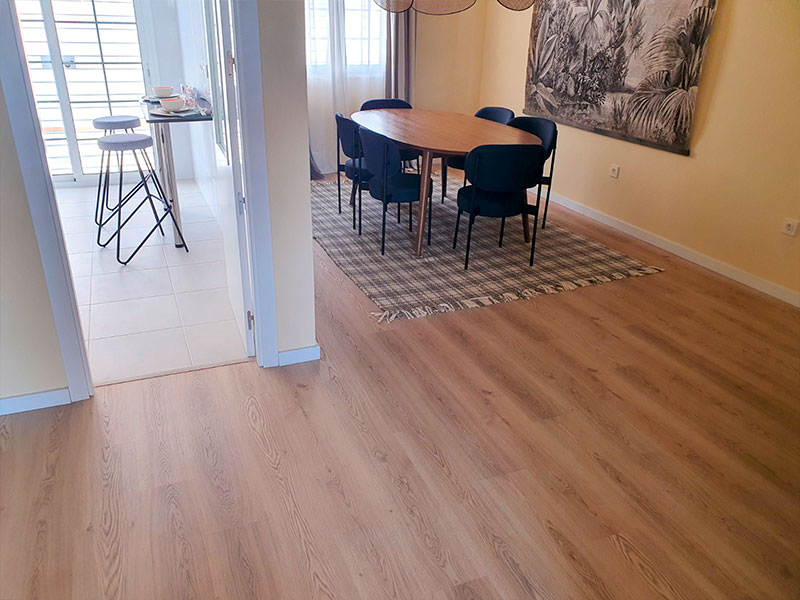
Short answer: for living rooms, bedrooms and hallways we usually recommend laminate flooring, which feels and looks closer to wood. For bathrooms, kitchens or areas that often get wet, vinyl flooring or a water-resistant laminate range. The biggest difference between the two is how they behave with water.
At Payresa we sell and install both from our showroom in Malaga, so this comparison does not favour one or the other: each has its place.
Laminate and vinyl: the differences in a table
| Laminate flooring | Vinyl flooring | |
|---|---|---|
| What it is made of | High-density fibreboard (HDF) core, decorative paper and a melamine top layer | Multi-layer PVC, with a clear wear layer on top |
| Water | The core swells if water gets into the joints; water-resistant ranges withstand spills depending on the model | The material does not absorb water; suitable for bathrooms and kitchens |
| Feel and sound | More rigid and closer to wood; needs a good underlay so it does not sound hollow | Softer and quieter underfoot |
| Wear | Measured by AC class (AC4 is usually enough for a home) | Depends on the thickness of the wear layer and the use class |
| Installation | Floating with click joints, over the existing floor if it is firm and level | Click, glue-down tiles or roll, also over the existing floor |
| Where it works best | Living rooms, bedrooms, hallways | Bathrooms, kitchens, commercial premises, damp areas |
What each one is
Laminate flooring is a high-density fibreboard (HDF) panel with a printed decorative layer, usually a wood effect, and a melamine top layer that protects against wear. It is laid as a floating floor, with the boards clicked together over an insulating underlay.
Vinyl flooring is made of PVC. It is sold as click planks or tiles (what is usually called LVT), as glue-down tiles and in rolls. The latter is standard in hospitals, care homes and commercial premises, where it matters that there are no joints.
Water and damp: the biggest difference
Vinyl does not absorb water, so it withstands mopping and spills in any room. Even so, water should not be left sitting under the skirting board for days.
Laminate has a wood fibre core. If water gets into the joints and is not dried in time, the board swells and hardly ever recovers its shape (we explain this in how to repair a wet floating floor). Water-resistant ranges have treated joints and cores that withstand spills for a period of time, specified by each manufacturer, but they are not waterproof like vinyl.
In homes by the sea or on ground floors, damp often comes from the subfloor. In that case the material makes no difference: what protects the floor is laying an underlay with a damp-proof barrier and checking the moisture before installing, which is what we do during the visit. More detail in the best flooring for a damp home.
Comfort, sound and appearance
Vinyl is softer and better at dampening the noise of footsteps. Laminate is more rigid and feels more like wood underfoot, but without a suitable underlay it sounds hollow (see the best underlay for laminate flooring).
In terms of appearance, both imitate wood very well in the mid and high ranges. The difference shows in the budget ranges: cheap vinyl can look plasticky and cheap laminate repeats the pattern too often.
Wear: AC class and wear layer
For laminate, abrasion resistance is measured by the AC class in standard UNE-EN 13329. For a home, AC4 is designed for heavy domestic use and is usually enough, even with children and pets; AC5 is for commercial premises and high-traffic areas. We explain it in AC4 or AC5: which to choose.
For vinyl, what matters most is the thickness of the wear layer, the clear layer on top, and the use class stated by the manufacturer. A thin wear layer scratches sooner, especially with sand or furniture legs without felt pads.
Which is cheaper, laminate or vinyl?
The cheapest models on the market are vinyl, especially in rolls or self-adhesive. In the mid and high ranges, prices get closer, and laminate usually offers very good value for money for dry rooms.
At Payresa, installation labour costs the same whichever material you choose. What changes the total is the model, the square metres, the underlay and the trimming around doors and wardrobes. That is why we do not give generic rates: after a free visit and measurement, the quote is fixed and in writing.
Which to choose for each room
- Living room, bedrooms and hallways: AC4 laminate, for its wood-like feel and look.
- Kitchen: vinyl or a water-resistant laminate range. We compare them in vinyl or laminate flooring for kitchens.
- Bathroom: vinyl.
- Commercial premises, offices and high-traffic rental flats: commercial-grade vinyl or AC5 laminate.
- The same floor throughout the house: if you want continuity including the kitchen and bathroom, vinyl lets you use a single material in every room.
Where we have installed them
Some recent Payresa projects with each material:
- Laminate: Pergo in the 76 homes at Las Lagunas de Mijas and in the 28 homes at Asian Park in Malaga; Intafloor in the 54 homes at Terrazas de Guadaiza (Marbella); Kronotex in the 147 homes at Hábitat Sofía (Mairena del Aljarafe).
- Vinyl: Tarkett and Gerflor PVC flooring in the Axarquía Hospital extension and Gerflor roll flooring.
At our showroom at C/ Tucídides, 44 (Malaga) you can see both materials and check how a Pergo laminate floor we laid 25 years ago has aged.
Frequently asked questions
Can laminate or vinyl be laid over tiles?
Yes, both can, without removing the tiles, as long as they are firm and level. An insulating underlay with a damp-proof barrier is laid under the laminate. We explain how in how to lay a floating floor over tiles.
What goes under vinyl flooring?
It depends on the format. Click vinyl is laid floating over the underlay specified by the manufacturer; some models come with it already attached. Glue-down vinyl and sheet vinyl are bonded directly to a smooth, level subfloor, because any irregularity shows through the material.
Which is more expensive, vinyl or laminate flooring?
In basic ranges, sheet or self-adhesive vinyl tends to be cheaper; in mid and high-end ranges, prices are closer. What affects the total most is the model chosen and the condition of the subfloor.
Which is better with underfloor heating?
There are models of both that are suitable for underfloor heating, with the right underlay; each manufacturer specifies this. More detail in the best floating floor for underfloor heating.
How long does it take to install laminate flooring?
As a guide, one fitter lays about 10 m² of laminate a day. The final timescale depends on the square metres, the furniture and the trimming, and you can walk on it straight away.