
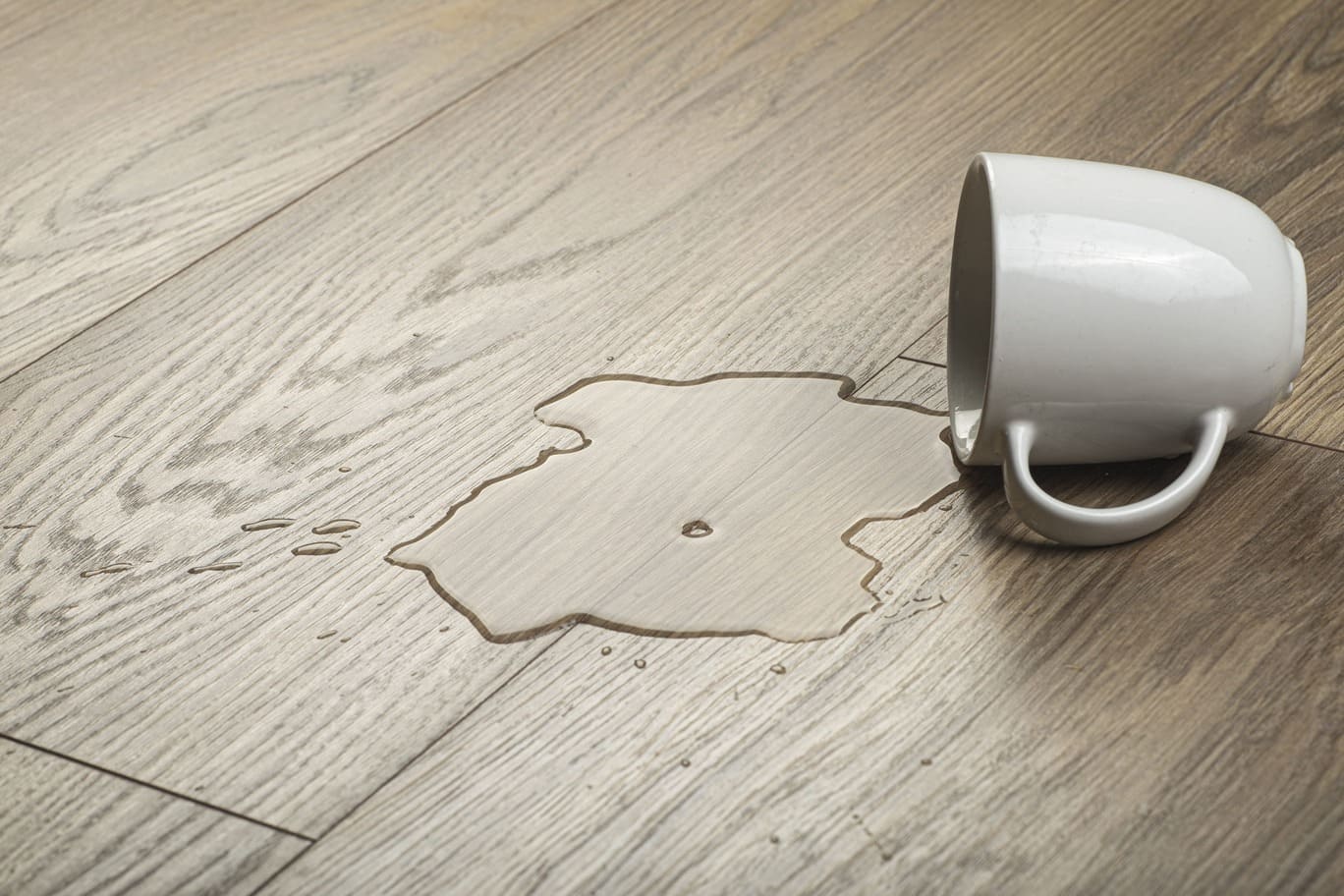
Short answer: if the water has stayed on the surface, dry it straight away and the floor will not suffer. If it has got into the joints, dry it with warm air and ventilate for days. If the boards are already swollen or bulging, a laminate floor will hardly ever go back to its original shape: they need replacing, and first you have to find out where the water is coming from.
At Payresa we have been installing floating floors in Malaga since 1976. This guide explains what you can do yourself and when it is best to have a professional take a look.
Quick diagnosis: what you see and what it means
| What you see | What it usually means | What to do |
|---|---|---|
| Water or liquid on the floor, with no marks | It has not got into the joints | Dry with paper towel or a cloth and ventilate |
| Joints slightly raised along the edges of the boards | Water has got into the joins | Dry with warm air and ventilate for several days; keep an eye on whether it goes down |
| Visibly bulging or swollen boards | The core of the board has swollen | Replace the affected boards, after drying the subfloor |
| Floor lifting without anything having been spilt | Damp coming up from below or a leak, or no expansion gap | Find the cause before repairing anything |
Why water damages floating floors
Most floating floors are laminate: they have a high-density wood fibre core that expands when it absorbs water. When water gets into the joints, the edges of the boards swell, the joins lift and bulges can appear. The longer the damp remains, the greater the damage.
Not all of them react in the same way:
- Laminate flooring: the most sensitive. A swollen board rarely recovers its shape.
- Wood floorboards (with a natural wood top layer): can partly recover as they dry and, depending on the thickness of that layer, can be sanded afterwards.
- Vinyl flooring: the material does not absorb water. If it gets wet, simply dry it; the problem only arises if water sits underneath for days.
What to do in the first few minutes
- Cut off the source of the water if it is a leak: stopcock, washing machine, dishwasher or fridge.
- Dry the surface with kitchen roll or a dry cloth. Do not mop: you would spread the water into other joints.
- Remove any wet rugs and furniture on top.
- Ventilate the room to speed up drying.
In many cases, acting quickly prevents any damage.
How to dry the floor when water has got into the joints
- Use a hairdryer on a warm setting, never too hot, aimed at the joints for several minutes.
- Keep the room ventilated; a dehumidifier helps if the air is humid.
- If the water reached the edges of the room, remove the skirting board in that area so that the subfloor can breathe.
- Be patient: drying out completely can take days.
Do not use steam, floor scrubbers, heaters or intense direct heat: they warp the boards and make the problem worse.
When boards need replacing
If the boards are still raised or bulging after drying, the damage is no longer superficial. With laminate flooring, once a board has visibly swollen, the usual solution is to replace it.
The process is:
- Take up the floor from the nearest wall to the damaged boards (as it is floating with a click system, it can be taken up without breaking the sound boards).
- Dry the subfloor and underlay thoroughly, and replace the underlay if it is soaked.
- Fit new boards of the same model and lay the floor again.
That is why we recommend keeping any leftover material after installation. If the model is no longer made, a similar board can be fitted in a less visible area, such as under a piece of furniture, and the original moved to the damaged area.
If the floor lifts without getting wet
When no water has been spilt, the cause is usually something else:
- Damp from the subfloor: common on ground floors and in homes near the sea if no damp-proof barrier was fitted.
- A hidden leak: pipes under the floor or near the kitchen and bathroom.
- No expansion gap: the floor moves with the humidity in the air. If it touches the wall, a fixed piece of furniture or a door frame, it lifts as it expands.
In these cases, replacing boards will not help unless the cause is fixed first. If the damage comes from a leak, check your home insurance policy before lifting anything: many cover water damage and will want to see it.
Mistakes that turn a simple repair into a big one
- Using heaters or intense direct heat.
- Mopping to "clean up" the water.
- Leaving it several days without doing anything.
- Replacing boards without finding out where the damp is coming from.
How to stop it happening again
A lot depends on how the floor was installed. In our installations:
- We check the moisture and levelness of the floor during the initial visit: the subfloor must be level, clean and dry.
- We lay an underlay with a damp-proof barrier between the floor and the floorboards, on ground floors too.
- We leave expansion gaps around the perimeter and a threshold profile at every doorway, which is what the manufacturers require.
- In kitchens, bathrooms and homes by the sea, we recommend vinyl flooring or a water-resistant laminate range (see laminate or vinyl flooring).
And day to day: always wring the mop out well, put rugs by the sink and at the entrance, and dry up spills straight away. More tips in how to clean a floating floor.
Frequently asked questions
Does a swollen floating floor go back to normal?
If only the edges have lifted slightly, it sometimes goes down after several days of drying. If the laminate board is visibly bulging, it rarely recovers and has to be replaced.
Can you replace a single floating floorboard?
Yes. As it has a click system, the floor is taken up from the wall to the damaged board and laid again with a new one of the same model.
Is vinyl flooring damaged by water?
The material does not absorb water, so it can withstand spills and mopping. The only thing to avoid is water sitting underneath, for example under the skirting board, for days.