
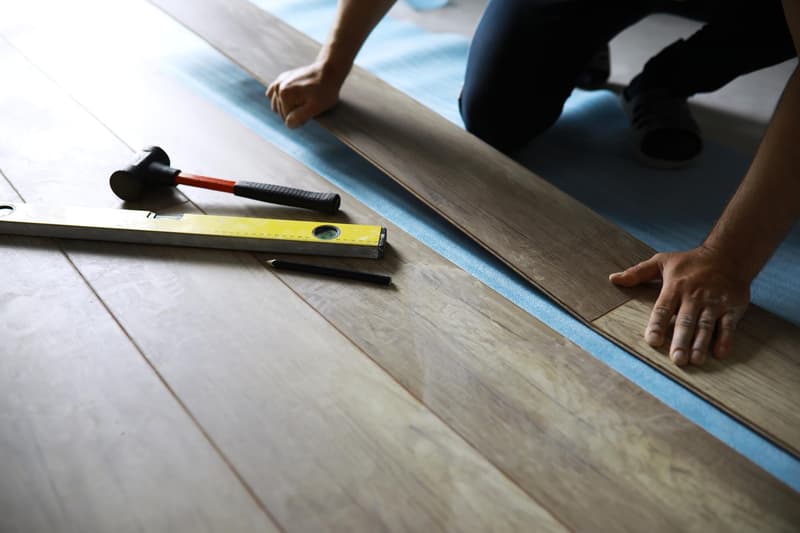
What is wood laminate flooring?
It is a type of floor covering made up of several layers of wood-based or synthetic materials that realistically imitate different finishes. The finishes imitate wood (the most common), polished concrete, a rusted effect, ceramic tiles and so on.
Laminate floors are very hard-wearing and are classified mainly according to their intended use and their resistance to impact and wear.
Pros and cons of laminate flooring
Pros
- Cheaper than natural wood.
- A huge range of designs, colours and finishes.
- It can be laid over the existing floor if it is properly level.
- It resists scratches, knocks and stains well.
- Easy to clean and maintain.
- Some models are compatible with underfloor heating (the manufacturer will state this).
Cons
- It cannot be sanded or varnished like wood: if a board gets damaged, it has to be replaced.
- Standing water in the joints makes it swell; water-resistant models hold up better, but they are not waterproof like vinyl.
- Without a good underlay, it sounds hollow underfoot (see the best underlay for laminate flooring).
Types of wood laminate
By use class
This is the main system used to classify the different types of laminate flooring according to their intended use. It splits them into 2 broad groups, suitable for domestic and commercial use. Within these groups, it then subdivides them into three levels of use: moderate, general and heavy, each with its own number:
- Domestic use:
- Moderate
- General
- Heavy
- Commercial use:
- Moderate
- General
- Intensive
This classification follows the European standard EN 13329, which sets out the specifications and tests for classification. The following parameters are assessed:
- Abrasion resistance (AC)
- Impact resistance (IC)
- Stain resistance
- Resistance to surface burns
- Effects caused by furniture legs and other objects
- Thickness swelling
By AC rating
The AC rating measures the surface or abrasion resistance of different types of flooring, including laminate.
Although it only measures one aspect, many consumers focus on this figure and treat it as a sign of the floor's quality. In Payresa's view, this is a mistake, as it ignores many other factors that matter more.
The UNE-EN 13329 standard defines the classes from AC1 (the lowest) to AC5 (maximum abrasion resistance). Some manufacturers advertise "AC6" models, but that class does not exist in the standard: it is their own trade name.
For a home, AC4 is designed for heavy domestic use and is usually enough, even with children and pets. AC5 is reserved for commercial premises, offices or rental flats with a lot of foot traffic. These days it is hard to find laminate below AC3.
If you are torn between the two most common classes, we explain it in AC4 or AC5: which to choose.
By design
As mentioned above, the aesthetic possibilities of this type of flooring are enormous. We could divide them into different types:
- Wood, parquet and/or laminate effect. These are the most common and the most sought after.
- Tile effect: sandstone, encaustic tiles, marble…
- Creative designs. Original models offered by some manufacturers.
From a design point of view, there are a number of things to look at:
- Design quality. This is obvious and, in many cases, very easy to spot. A poor, unrealistic printed design is plain to see.
- The size and/or repetition of the pattern. Especially with wood-effect laminate, if the number of different boards available is limited, the result can look artificial, even if the design itself is high quality.
- Quality of the texture. The surface of laminate is not completely smooth but has a certain texture. In quality laminate, this texture is also synchronised with the design. In other words, you can not only see the wood grain, you can feel it.