
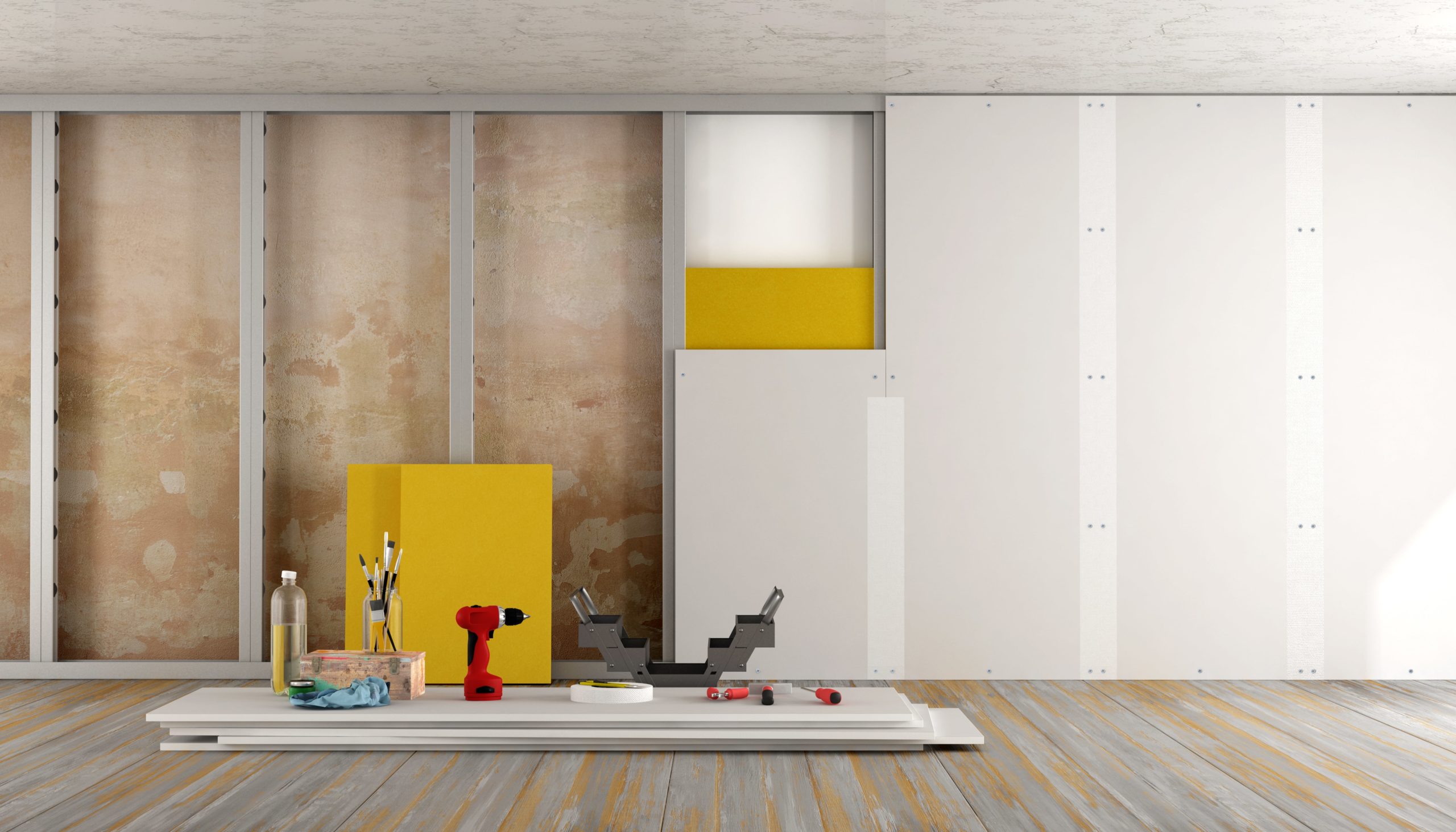
Short answer: there are three ways to put plasterboard on a wall. If the wall is in good condition and you want to lose as little space as possible, go for direct lining: the boards are bonded to the wall. If the wall is out of true or you want to add insulation or run services, use stud lining. And if you want to divide a room, build a partition with metal studs and boards on both sides. All three are dry construction: gypsum plasterboard, with no bricks or mortar.
What is plasterboard?
Plasterboard consists of gypsum boards: a gypsum core between two sheets of paper liner. The gypsum gives it compressive strength and the paper, flexural strength. In Spain, "Pladur" is a brand that has become the generic name for this material.
Lining or partition: which do you need?
| Solution | What it is | When to use it |
|---|---|---|
| Direct lining | Boards bonded to the existing wall with adhesive compound | Sound, dry and fairly straight walls; when you want to lose the minimum of space |
| Stud lining | A metal stud frame in front of the wall with the boards screwed on | Uneven walls; to add thermal or acoustic insulation, or to run services |
| Partition | Tracks on the floor and ceiling, vertical studs and boards on both sides, with insulation inside | Dividing a room or building a new wall |
Which board to use in each room
- Bathrooms and damp areas: moisture-resistant board, the one with green paper.
- Kitchens and next to fireplaces: fire-resistant board, the one with pink paper.
- To separate rooms with noise: acoustic board, the blue one.
- Rest of the home: standard board.
If the aim is soundproofing, the board is only part of it: the insulation in the cavity and the strips on the studs count just as much. We explain it in how to soundproof a room.
Materials needed
- Plasterboard of the right type for the room.
- Metal profiles: tracks (horizontal, on the floor and ceiling) and studs (vertical). They are not needed for direct lining.
- Adhesive compound, only for direct lining.
- Sealing or acoustic strip between the profiles and the floor, ceiling and walls, to cut out vibrations.
- Insulation (mineral wool in slabs or rolls) for the cavity, if you want to insulate.
- Specific screws for boards and for profiles.
- Joint tape and jointing compound.
- Tools: utility knife, straightedge, spirit level or laser, screwdriver and taping knives.
How to install plasterboard on walls with studs, step by step
- Set out: mark on the floor and ceiling where the frame will go, using a level or laser, and check that the lines are plumb.
- Fix the tracks to the floor and ceiling, with the sealing strip underneath.
- Fit the vertical studs inside the tracks, at the spacing specified by the board manufacturer.
- Run the services (cables, pipes) through the studs before closing up.
- Plan reinforcements where you are going to hang heavy items: wall-mounted kitchen units, televisions, shelves.
- Screw the first layer of boards to the studs, butted tightly together with staggered joints, without driving the screw in so far that it breaks the paper.
- Fit the insulation in the cavity and, if it is a partition, close it with the second layer.
- Finish the joints with tape and compound in several thin coats, sanding between them.
- Paint once dry.
How much weight can a plasterboard wall hold?
It depends on the type of board, the frame and the fixing. For pictures and light objects, specific plasterboard plugs are enough. For heavy loads, the right approach is to plan a reinforcement inside the wall before closing it and fix to that. Always follow the values given by the plug manufacturer.
Common mistakes when installing plasterboard on walls
- Using standard board in a bathroom or next to the shower.
- Not fitting a sealing strip: the partition transmits noise and vibrations.
- Forgetting the reinforcements for hanging heavy units.
- Driving the screws in too far or leaving them proud: they show through when painted.
- Finishing the joints in a single thick coat: they end up showing or cracking.
- Applying direct lining to a damp wall: the damp has to be dealt with first.
Advantages of installing plasterboard on walls
- Dry construction: no bricks or mortar, much cleaner and quicker than traditional partition walls.
- Concealed services without chasing the wall.
- Better thermal and acoustic insulation with the right board and insulation.
- Straight, smooth walls, ready to paint.
Frequently asked questions
Can plasterboard be fixed directly to the wall?
Yes, with direct lining, bonding the boards with adhesive compound, as long as the wall is sound, dry and fairly straight. If not, it is better to use studs.
Does installing plasterboard on walls involve building work?
It is dry construction: boards screwed to metal profiles or bonded to the wall, with no bricks or mortar. It goes up quickly and makes much less mess than traditional partition walls.
Does plasterboard block noise?
Yes, with the right board and insulation in the cavity. A well-built plasterboard partition can insulate better than a thin brick wall.
If you also want to do the ceiling, we explain it in how to install a plasterboard ceiling.