
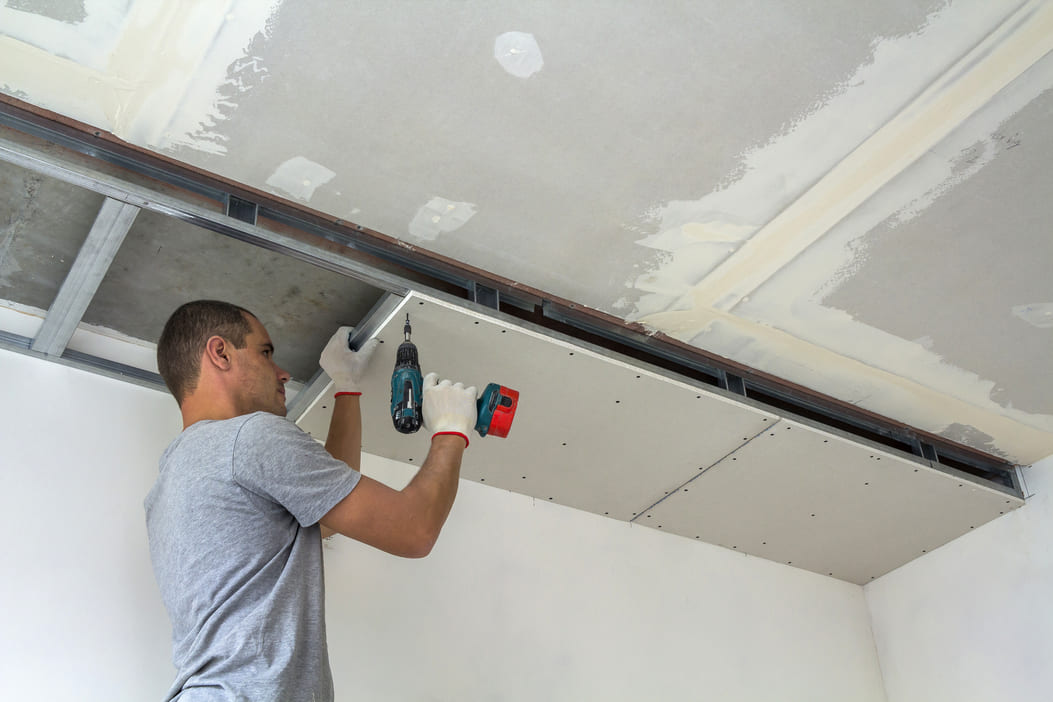
Installing a plasterboard ceiling may look like a simple job, but in practice it is one of the installations where we see the most mistakes when it is done without experience. At Payresa, a Malaga flooring and wall covering company since 1976, we install plasterboard ceilings in homes and commercial premises in Malaga. In this guide we tell you what works, what doesn't and when it is best left to professionals.
In short: a plasterboard ceiling goes up in four stages: the height is marked around the perimeter, a frame of metal profiles is hung from the original ceiling, the boards are screwed on (moisture-resistant in bathrooms, fire-resistant in kitchens, standard everywhere else) and the joints are finished with tape and compound before painting. It is dry construction, with no brick or mortar, and what shows most in the result is how well levelled the frame is.
If you would rather we did it for you, take a look at our plasterboard installation service in Malaga.
What a plasterboard ceiling is and when it is recommended
A plasterboard ceiling (or false ceiling made of gypsum plasterboard) is mainly used to:
- Conceal electrical, air-conditioning or telecoms installations
- Improve thermal and acoustic insulation
- Lower the visual height of a room
- Achieve a clean, modern finish
It is a very common solution in flats, villas and commercial premises, but installing it correctly is key to avoiding cracks, uneven surfaces or problems over time.
Plasterboard consists of gypsum boards between two layers of paper liner: the gypsum gives it compressive strength and the paper, flexural strength. Compared with other materials such as solid plaster, fibrous plaster or brick, it stands out for its easy installation, its ability to adapt to any surface and its cleanliness, as it is dry construction. As well as ceilings, it is used to line walls, build interior partitions and even make furniture.
Before you start: things to consider
Before installing a plasterboard ceiling, we always recommend checking:
- Available height in the room
- Type of original ceiling (slab, concrete, joists…)
- Weight it will have to bear (light fittings, ducts, insulation)
- Humidity level of the space
These factors determine the type of frame and boards to be used.
Common materials for installing a plasterboard ceiling
These are the materials most commonly used in a professional installation:
- Perimeter and secondary metal profiles
- Threaded rods, hangers and anchors
- Suitable plasterboard (standard, moisture-resistant, fire-resistant…)
- Plasterboard-specific screws
- Jointing compound and tape
Having the right materials is as important as knowing how to fit them.
Types of plasterboard for ceilings
Although the basic structure is always gypsum and paper, the board's core varies according to its use. These are the most common ranges:
- Pladur N: the standard board, suitable for most applications in dry areas.
- Pladur TEC: similar to the standard board, but reinforced for continuous ceilings.
- Pladur WA: with a water-repellent treatment, water-resistant; suitable for bathrooms or porches. On site it can be recognised by its green paper.
- Pladur FOC: fire-resistant thanks to the glass fibre in the gypsum core. Its paper is pink.
- Pladur GD: with reinforced hardness, for areas exposed to impacts such as commercial premises, schools or hospitals.
- Pladur FON: perforated boards with a glass fibre fleece on the back to improve sound absorption; useful in cinemas, restaurants, assembly halls or communal areas of residential buildings.
How to cut plasterboard
Cutting gypsum plasterboard is easy: all you need is a utility knife and a straightedge or guide so the cut comes out straight. Cut through the first layer of paper, snap the board along the line and run the knife along the other side. If the edge is rough, run a hand plane over it a couple of times to smooth it.
Tips on how to put up a plasterboard ceiling
Installing a plasterboard ceiling may seem complicated, but with a few key tips you can achieve a professional finish even without much experience. The first thing is to measure the surface carefully and mark the guidelines correctly on the walls and ceiling, as poor levelling can ruin the whole job. Always use a laser or spirit level to ensure accuracy.
Another essential point is to choose good-quality metal profiles and fix them properly with plugs suited to the type of original ceiling. Make sure the frame is solid before fitting the boards. When screwing the plasterboard, do not overtighten, to avoid damaging the material.
Fit the boards butted tightly together with staggered joints, so that they do not line up. Then apply tape and specific jointing compound in several thin coats, sanding lightly between them for a perfect finish.
Finally, plan the lighting or cabling carefully before closing the ceiling. Having everything ready will save you time and complications. With patience and precision, the result will be clean, strong and flawless.
How to install a plasterboard ceiling step by step
1. Mark the ceiling height
Mark the perimeter of the room at the desired height, taking into account:
- Thickness of the boards
- Space for services
- Any insulation
Getting the levelling right at this point is essential for a good result.
2. Fit the perimeter profiles
The profiles are fixed to the walls with screws and plugs, usually every 40–50 cm. These profiles will be the base of the whole frame.
3. Build the suspended frame
Threaded rods are installed in the original ceiling and the main and secondary profiles are fitted to form a stable grid. A poorly calculated frame leads to sagging, vibrations and cracks.
4. Fit the plasterboard
The boards are screwed to the metal frame, respecting the spacing and making sure the joints do not line up. The type of board will depend on how the room is used:
- Standard board for dry areas
- Moisture-resistant board for bathrooms or kitchens
- Fire-resistant board for commercial premises or plant areas
5. Joint finishing
The joints are filled with specific compound and tape, applying several coats until the surface is even. This step is key to stopping the joints from showing over time.
6. Final finish
Once dry, the ceiling can be lightly sanded and painted. Mouldings, recessed lighting or decorative systems can also be added.
Common mistakes when installing a plasterboard ceiling
These are the most common faults:
- Not leaving enough space for services
- Poorly levelled frame
- Badly placed screws
- Using the wrong boards
- Not respecting expansion joints
These mistakes usually show up months later and mean the work has to be redone.
When is it best to call in professionals?
If the ceiling includes recessed lighting, acoustic insulation or large surfaces, or needs a perfect finish, professional installation makes all the difference in durability and appearance.
Plasterboard ceiling FAQs
Which plasterboard is used for ceilings?
In bathrooms and damp areas, moisture-resistant board (the one with green paper). In kitchens and next to fireplaces, fire-resistant board (the pink one). If you want to improve the acoustics, acoustic or perforated board. In the rest of the home, standard board.
Which is better, a plaster or a plasterboard ceiling?
Plaster allows mouldings, curved shapes and a very fine finish, but it is more sensitive to damp and needs more labour. Plasterboard goes up faster, can use moisture-resistant boards and is easier to repair. If you need frequent access to services, a suspended ceiling with removable tiles is the better choice. More detail in plaster ceilings.
How much ceiling height do you lose with plasterboard?
The minimum is a few centimetres, but it depends on what has to be hidden: air ducts or pipes mean it has to come down further.
How much does a plasterboard ceiling cost?
It depends on the square metres, the type of board, the frame required, whether it includes insulation and the number of recessed lights. That is why the price is usually given after measuring the room.
What are the drawbacks of a plasterboard ceiling?
If the frame is not properly levelled or the joints are badly finished, cracks and visible joints appear. To hang light fittings or heavy items you need to plan for reinforcement or specific anchors. And in damp areas it only works with moisture-resistant board.
Need a plasterboard ceiling installed in Malaga?
If you are thinking of installing a plasterboard ceiling and want a long-lasting, well-finished result, at Payresa we can advise you and carry out the plasterboard installation with full guarantees.
If you are also going to line or build walls, we explain it in how to install plasterboard on walls.