
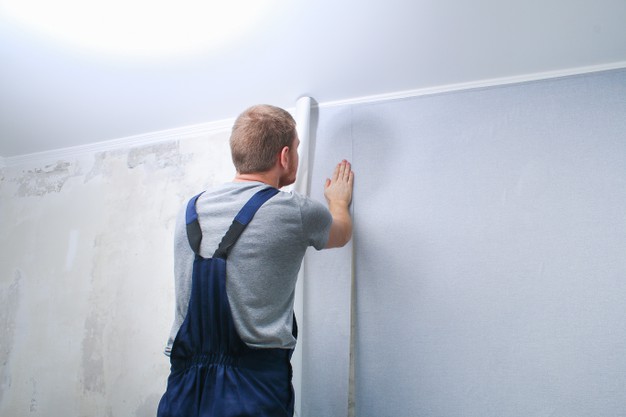
Short answer: clean and dry the wall thoroughly, position the vinyl and fix it with masking tape across the middle (the "hinge" method), peel the backing paper off one half, stick it down with a squeegee from the centre outwards, repeat with the other half and remove the transfer paper keeping it very close to the wall. If the wall has just been painted, wait until the paint is completely dry.
This guide is for self-adhesive decorative vinyls (quotes, designs, murals). If what you are looking for is to cover whole walls with a washable, hard-wearing material, see the difference with vinyl wall coverings at the end.
What you need
- The vinyl, with its backing paper (behind) and its transfer paper (in front).
- A plastic squeegee or felt-edged scraper (it usually comes with the vinyl).
- Masking tape.
- Tape measure, pencil and spirit level.
- A dry cloth and, if the wall is dirty, water with a little neutral soap.
- A pin or fine needle, in case a bubble is left.
How to apply vinyl to a wall step by step
1. Prepare the wall
The wall must be smooth, clean, dry and free of dust. If you clean it with soap and water, let it dry completely before you start. If it has just been painted, wait until the paint has fully cured: the adhesive may pull it off or fail to grip.
2. Prepare the vinyl
Unroll it on a flat surface and run the squeegee firmly over the transfer paper so the design is well stuck to it. If it comes in several pieces that you want to apply separately, cut them out now.
3. Position and level it
Place the vinyl on the wall with the backing paper facing the wall, check it with the spirit level and mark the corners in pencil. Stick a strip of masking tape vertically down the middle to act as a hinge.
4. Stick down the first half
Lift one half of the vinyl over the hinge, peel the backing paper off that half up to the tape and cut it off. Lower the vinyl onto the wall little by little, running the squeegee from the centre towards the edges to push the air out.
5. Stick down the second half
Remove the hinge tape, lift the other half, peel off the rest of the backing paper and squeegee again from the centre outwards.
6. Remove the transfer paper
Start at one corner and pull the transfer paper off slowly, at a very sharp angle and close to the wall, not towards you. If any part of the design comes up with the paper, press it back down, run the squeegee over it and carry on.
7. Deal with any bubbles
If a small bubble is left, prick it with a pin and smooth it towards the hole with your finger or the squeegee.
Where vinyl doesn't stick well
- Textured (gotelé) or rough walls: the vinyl only touches the high points and ends up peeling off.
- Freshly applied paint or paints that leave dust on your finger when you touch them.
- Walls with damp or condensation, such as some bathrooms without ventilation.
- Greasy surfaces, for example next to the kitchen, if they are not cleaned first.
How to remove a vinyl without damaging the wall
Warm the vinyl with a hairdryer to soften the adhesive and peel it off slowly from one corner, pulling parallel to the wall. Any glue residue usually comes off with warm water and soap.
Decorative vinyl or vinyl wall covering
They are not the same thing. Decorative vinyl is a thin adhesive used to decorate an area. A vinyl wall covering is a technical material in rolls or sheets that covers whole walls: washable and resistant to knocks and scuffs, designed for hotels, clinics, offices, corridors and communal areas. It is not applied with transfer paper but bonded to the wall like a technical wallpaper, and it is the one we install at Payresa.
Frequently asked questions
How long does a wall vinyl last?
It depends on the quality of the vinyl, the wall and how much light it gets. On a smooth, dry wall out of direct sunlight, a good-quality vinyl lasts for years.
Can you put a vinyl on a textured (gotelé) wall?
It is not recommended: the vinyl does not rest on the whole surface and peels off. The wall would need to be smoothed first.
Can you put a vinyl in the bathroom?
Yes, in an area that does not get wet directly and has good ventilation. Next to the shower, with constant condensation, it peels off sooner.